
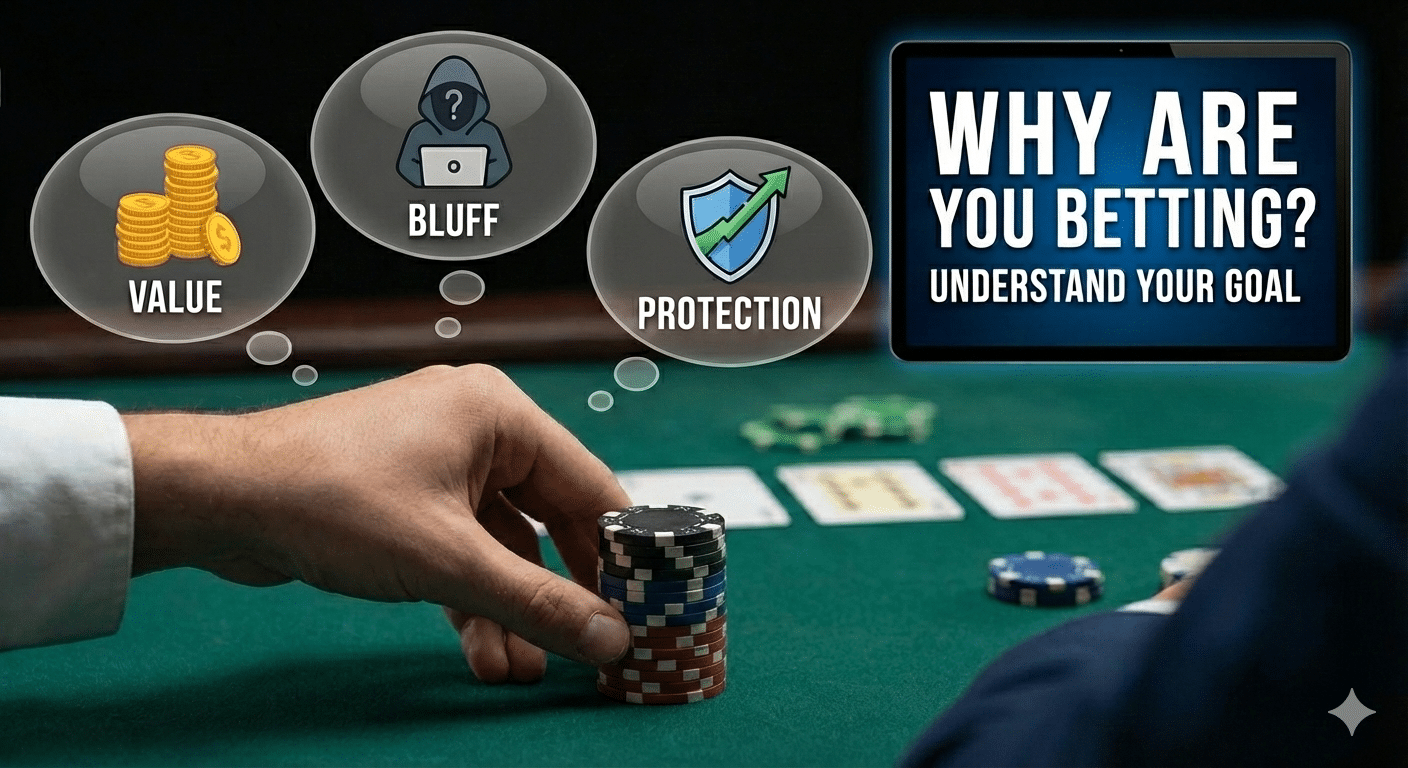
Think about why you’re betting so you can make better decisions on every street.
You raise preflop with 5♠️ 5❤️, the flop comes Q❤️ 6♠️ 2♣️. Do you bet? If you read the last article about continuation betting, you may know that the answer is probably “yes.” But here’s the real question: why should you bet with this specific hand? What are you trying to accomplish? Do you want your opponent to call? Fold?
Understanding why you’re betting is just as important as deciding whether to bet.
The Three Reasons to Bet
In our last article, we discussed that betting after you raise preflop gives you two ways to win: you can make the best hand, or you can win when your opponent folds. But that’s the simplified version. The truth is, when you bet, you’re usually doing one of three things:
- Betting for value – You want your opponent to call with a worse hand
- Betting as a bluff – You want your opponent to fold a better hand
- Betting for protection – You want your opponent to have to pay to try to make a better hand1
Let’s break down each one using that Q❤️ 6♠️ 2♣️ flop.
Betting for Value: Building the Pot with Strong Hands
When you bet for value, you have a strong hand and you want to build a bigger pot that you have a good chance of ultimately winning. You’re hoping your opponent calls because you think your hand is better than the types of hands that they would call with.
Example: You raised preflop with A♠️ A❤️ and the flop comes Q❤️ 6♠️ 2♣️. You have an overpair—a very strong hand on this board. When you bet, you want hands like K❤️ Q♣️ or 10♠️ 10❤️ to call and put more money in the pot. You’re the favorite to win, so you want the pot to get bigger.
The key question for value betting: “Do I want my opponent to call?” If yes, you’re betting for value.
Betting as a Bluff: Win Now with Nothing
When you bet as a bluff, you have a weak hand and you’re hoping your opponent folds. You don’t want a call—you just want to win the pot immediately.
Example: You raised preflop with 10♦️ 9♦️ and the flop comes Q❤️ 6♠️ 2♣️. You missed completely. You have nothing. But as we have learned, your opponent probably missed too. When you bet, you’re claiming to have a strong hand—trying to tell a story that you connected with this flop. If they fold, you win a pot you had no right to win.
But note: There are many situations where you should not be betting literally every hand. Instead, when you bluff, you will often want to have a draw—a hand that has a good chance of making a strong hand that is likely to win, such as a flush draw. This is sometimes called a semi-bluff.
The key question for bluffing: “Do I need my opponent to fold to win (unless I complete a draw on a later betting round)?” If yes, you’re bluffing.
Betting for Protection: Charging Draws to Chase You
This is the reason for betting that is probably least familiar to new players. When you bet for protection, you have a decent hand that’s probably ahead right now, but you don’t want to let your opponent see more cards for free with a worse hand if those cards could improve their hand to one that beats you. You’re making opponents pay to try to catch up.
Example: You raised preflop with 7♣️ 6♣️ on the same Q❤️ 6♠️ 2♣️ flop. You have middle pair—not amazing, but likely ahead of hands like 10♦️ 9♦️ or K♠️ 8♠️. You don’t want to give free cards that could make better pairs. By betting, you either win the pot now or make your opponent pay to see more cards.
Note: Medium-strength hands can be tricky, and as you gain experience, you’ll learn when checking is better than betting. For now, focus on recognizing when protection is your goal when you do decide to bet.
The key question for protection betting: “Am I ahead now, but vulnerable to being outdrawn?” If yes, you’re betting for protection (if you choose to bet).
Why This Matters
Here’s the key: All three types of bets look identical to your opponents. When you bet on that Q❤️ 6♠️ 2♣️ flop, your opponent has no idea whether you’re holding A♠️ A❤️, 10♦️ 9♦️, or 7♣️ 6♣️. They all look the same. That’s what makes it poker.
How This Affects Your Future Decisions
Your opponents may not know why you are betting, but you need to know which type of bet you’re making because it affects your future decisions:
- If you’re betting for value and get raised, you might want to continue in the hand (by calling or re-raising)
- If you’re betting for protection and get raised, you may need to fold
- If you’re bluffing and get called, you need to decide whether to keep bluffing on later streets (you will often want to continue bluffing when scarier cards come on the turn and river)
- If you’re betting for protection and get called, and then a scary card comes on the turn, you may want to slow down and play more cautiously
The Bottom Line
The next time you’re about to bet, pause and ask yourself: “Why am I betting?” Are you trying to build a pot, win it right now, or deny free cards? Each goal is valid, but knowing which one you’re pursuing makes you a much more thoughtful, effective player.
And remember: the best players mix all three types of bets together. Sometimes you bet with the nuts, sometimes with medium hands, sometimes with a pure bluff. Your opponents can’t tell the difference—and that’s exactly the point.
Your Challenge
In your next game, before you bet, consciously identify which type of bet you’re making: value, bluff, or protection. Just thinking about your reason for betting will improve your decision-making.
Coming next: Now that we have talked about whether to bet and why, our next few articles will address the question of how big to bet. We will start by discussing how different types of flops present different likely outcomes for the rest of the hand. Then, with that foundation laid, we will discuss some math and some strategy behind picking a good bet size.
- Modern poker theory generally refers to this concept as “equity denial” rather than “protection.” But “protection” is a simpler term that mostly gets the same point across. ↩︎