

You’ve learned when and how to bet. Now learn when not to.
Audio Version Available
Prefer to listen? Skip the reading.
6-min audio summary · Great for your commute · Same content, zero reading
You’re holding J❤️ J♣️ on a board of K♦️ T♠️ 8♣️. You bet, your opponent raises, and suddenly you have no idea what to do. Sound familiar?
Over the last several articles, we’ve built a strong case for betting. We’ve talked about the reasons to bet—for value, as a bluff, and to protect your hand. We’ve looked at how the board should influence your decisions. And we’ve discussed how to pick a bet size that matches the situation.
Now let’s talk about the other side of the coin: when you should check instead.
Before we go any further, let’s be clear about something. This article is not permission to go back to checking everything. Betting should still be a major part of your game—especially if you raised before the flop, if you are in position, or if you have a strong hand. But just like the best hitters in baseball don’t swing at every pitch, the best poker players don’t bet every time they can. They check when they have a reason to check. That’s the difference between strategic checking and checking just because you’re unsure or scared.
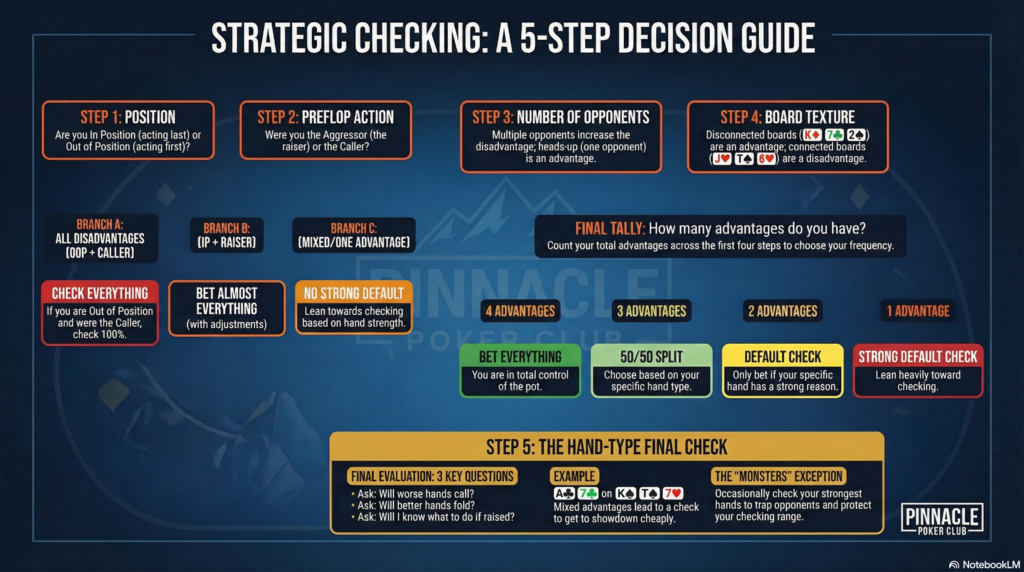
So how do you know when to check? Think of it as a checklist of advantages and disadvantages. When you have enough advantages, bet. When the disadvantages start stacking up, check. Let’s walk through them in order of importance.
Factor 1: Are You In Position or Out of Position?
This is the most important factor. When you’re in position (acting last), betting is safer and more effective. You get to see what your opponent does before you decide. And if you check, you know that the betting round is over—nobody can bet after you. You’re in total control. When you’re out of position (acting first), everything gets harder. If you bet and your opponent raises, you’re stuck making a tough decision. If you check, your opponent might bet and still put you to a tough decision. You have less control and less information.
Being out of position is a disadvantage that pushes you toward checking more.
Factor 2: Did You Raise Before the Flop, or Just Call?
The player who raised before the flop is generally playing stronger starting hands than the player who called. That matters after the flop, because it means the raiser is more likely to have hands like big pairs, A-K, and A-Q—the kinds of hands that don’t need to connect as much with the board to have a good chance of winning. The caller, on the other hand, is more likely to have speculative hands that need to hit something specific to continue playing.
Being the caller—not the raiser—is a disadvantage that pushes you toward checking more.
When Factors 1 and 2 Combine
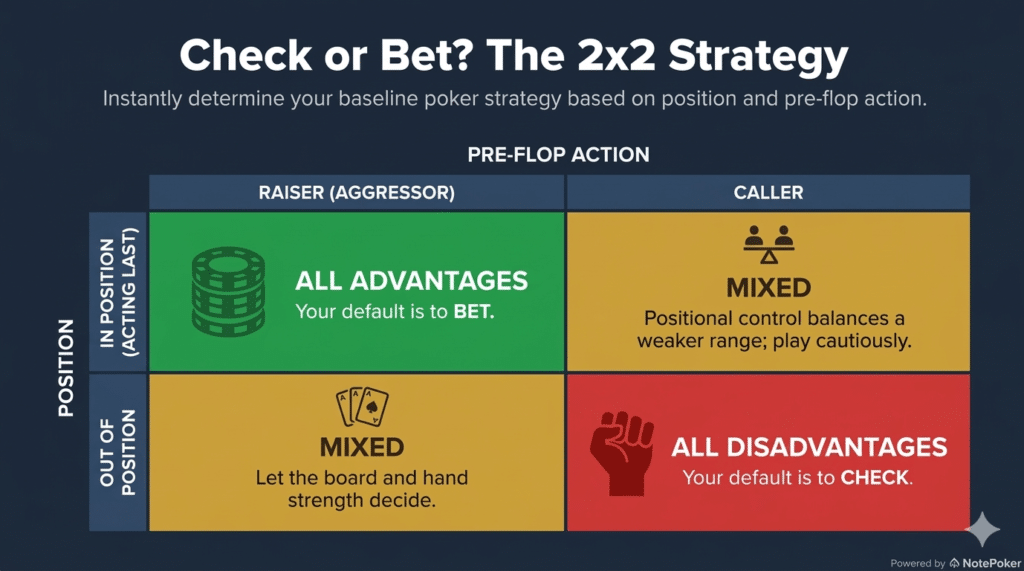
Here’s where it gets practical. These first two factors together set a baseline for how often you should check—before you even look at the board or think about your specific hand.
All disadvantages (you called before the flop and you’re out of position). This is most common when you are in the blinds and someone else raised. You’re playing weaker hands and you’re acting first. You should be checking almost all the time—essentially 100% of the time—regardless of what the board looks like or what you have. When you do have a strong hand in this spot, checking is still usually correct, because it sets up the option to check-raise (more on that in our next article).
All advantages (you raised before the flop and you’re in position). This is the sweet spot—you raised and your opponent called in the small blind or big blind. Your strong default should be to bet. You should only check when the remaining factors push you strongly toward it. We’ll get to those in a moment.
Mixed—you raised but you’re out of position. This often happens when you raise from early position and get called by someone in later position. You have the stronger hands, but you’re acting first, so you’ll decide whether to bet or check based on the remaining three factors.
Mixed—you called but you’re in position. This happens when someone raises and you call from a position other than the small blind or big blind. You have the positional advantage but are playing a somewhat weaker range of hands. Again, you’ll need to think about the next three factors to make your decision.
Factor 3: How Many Opponents Are in the Pot?
The more opponents you’re up against, the more likely it is that someone has connected with the board. This is the same principle we discussed in our continuation betting article: heads-up, you only need to beat one player. In a multiway pot, the chances that someone hit a good hand or draw go way up. Think of it like knocking on doors—knock on one door, and nobody might be home. Knock on four doors, and somebody’s answering.
Facing multiple opponents is a disadvantage that pushes you toward checking more.
Factor 4: What Does the Board Look Like?
We’ve talked about this in our articles on connected vs. disconnected and static vs. dynamic boards. The board texture tells you how likely your opponent is to have connected with the flop.
On a disconnected board like K♦️ 7♣️ 2♠️, most hands missed. This is an advantage that pushes you away from checking.
On a connected board like J❤️ T♠️ 8❤️, lots of hands have connected—pairs, straight draws, flush draws, two pairs. This is a disadvantage that pushes you toward checking more of your hands.
Think of it this way: the board helps determine how many of the different hands you could hold will be better off checking. On a disconnected board, only a few of your likely hands prefer to check (for the reasons discussed in the next section). On a connected board, many more of them do.
Factor 5: What’s Your Specific Hand?
Only after you’ve evaluated the first four factors—position, who raised, how many opponents, and the board—should you look down at your actual cards and ask: is this specific hand a good candidate for checking?
If you have all the advantages (you raised, you’re in position, it’s heads-up, and the board is disconnected), just bet almost everything. You don’t need to overthink your specific hand.
If you have all the disadvantages (you called, you’re out of position, it’s multiway, and the board is connected), check almost everything. Again, your specific hand barely matters for this decision.
But when you have a mix of advantages and disadvantages, that’s when your specific hand matters most. Here are three questions to ask yourself:
Will worse hands call my bet? You have 6♠️ 5♠️ on a board of J♦️ 9♣️ 5❤️ — bottom pair. If you bet, a hand like K♠️ 4♠️ just folds (you were already beating it), and a hand like 8♦️ 7♦️ calls with an open-ended straight draw and over cards that could easily beat you on the turn. You’re not getting value from worse hands and you’re building a pot against hands that might overtake you. That’s not a great deal. Checking gives you showdown value—your hand is probably good enough to win if it gets to a showdown, but not strong enough to bet for value.
Will better hands fold to my bet? If you have nothing and want to bluff, will a bet actually get your opponent to fold a hand that beats you? On a board of Q♣️ 9♣️ 7❤️ against two opponents, probably not—someone likely has something. Save your chips and check.
If my opponent raises, will I know what to do? This is the tiebreaker. If you bet and get raised, do you have an easy decision? If you have a very weak hand, you can fold easily. If you have a very strong hand, you can continue confidently. But if you have a hand in the middle—like J♣️ 7♣️ on J❤️ T♠️ 8❤️—a raise puts you in a nightmare spot. You don’t know if you’re ahead or behind, and the pot is getting big. Checking avoids that problem entirely.
The more “no” answers you get to these three questions, the more you should lean toward checking. This leads to a general principle: medium-strength hands and mediocre draws are the ones that you will want to check most often (assuming the situation calls for checking some of the time). Very strong hands want to bet for value because the opponent could call with a lot of worse hands. Very weak hands with no chance of winning can try a bluff because there are a lot of slightly better hands that the opponent could still fold. It’s the hands in the middle that benefit most from keeping the pot small and getting to showdown cheaply.
What counts as “medium strength” depends on the board. On a connected board like K♠️ T❤️ 8♣️, it might be bottom pair or a weak flush draw. On a disconnected board like 8♦️ 5♣️ 3❤️, it might be a hand like K♣️ Q♦️—which has some showdown value (it could be the best hand already) and a decent “draw” (any King or Queen gives you top pair).
One Exception: Checking a FEW of Your Strongest Hands
If you only ever check medium-strength hands, you create a problem: your opponents will learn that a check from you means you don’t have anything strong enough to fight back, and they’ll bet aggressively every time you check. That makes your life miserable with those medium hands, because now you’re always facing a bet with a hand you’re not confident about.
The solution is to occasionally check a few of your very strongest hands too—a hand like top set or pocket Aces on a safe board. These hands can afford to check because they’re so far ahead that a free card is unlikely to hurt them. And when you do check a monster and your opponent bets (thinking you’re weak), you can check-raise and win a much bigger pot than if you had just bet yourself.
This isn’t permission to slow-play every big hand—we’ve talked about how our opponents often check behind when we check, and you don’t want to miss value. But mixing in the occasional check with a monster serves an important purpose: it keeps your opponents honest. If checking might mean you’re weak or it might mean you’re setting a trap, they can’t just steamroll you every time you check. That protection makes all of your checks—even the ones with medium hands—much more effective.
We’ll see exactly how this works in our next article on check-raising.
Putting it all together
Imagine someone raises and you call with A♣️7♣️. The flop comes K♠️T♠️7♥️. Should you check or bet? Think it through step by step. You are in position—that’s an advantage. But your opponent raised before the flop—that’s a disadvantage (they are more likely to have a strong hand, like AA, KK, QQ, JJ, or TT). So, you’re in the middle on the first two factors.
You’re up against only one opponent—that’s an advantage—but the board is very connected (big cards, straight draws available, flush draws available)—that’s a disadvantage. With this balance of advantages and disadvantages, you will want to bet sometimes and check sometimes depending on your specific hand.
So what about this hand? Will worse hands call if you bet? Probably not. Hands like 66 or A5 will just fold.
Will better hands fold? Again, probably not. Hands with a King or a Ten will all call, as will hands like QQ and JJ.
What will you do if you get raised? You probably have to fold because your opponent could easily have hands like three of a kind or two pair. But you’re not happy about folding a decent hand like this.
So, just go ahead and check. Depending on how the rest of the hand plays out, you may be able to get to the showdown without facing any big bets. If that happens, you have a decent chance of winning the pot. But if you bet, you’re probably just building a pot for your opponent to win.
Your Challenge
The next time you are not sure whether to bet or check, think it through. Think about your position and remember who raised before the flop. Then, count your opponents and assess the flop. Finally, think about your specific hand and ask whether betting is likely to accomplish any purpose. Then, if checking makes sense, pay attention to what happens. Did your opponent bet? Did you save chips? Did you get to showdown cheaply and win? That’s strategic checking in action.
Coming up next: Now that you know when to check, the next two articles cover what happens when you’ve checked out of position and your opponent bets. First up: the most powerful move that almost nobody at our table uses—the check-raise.