
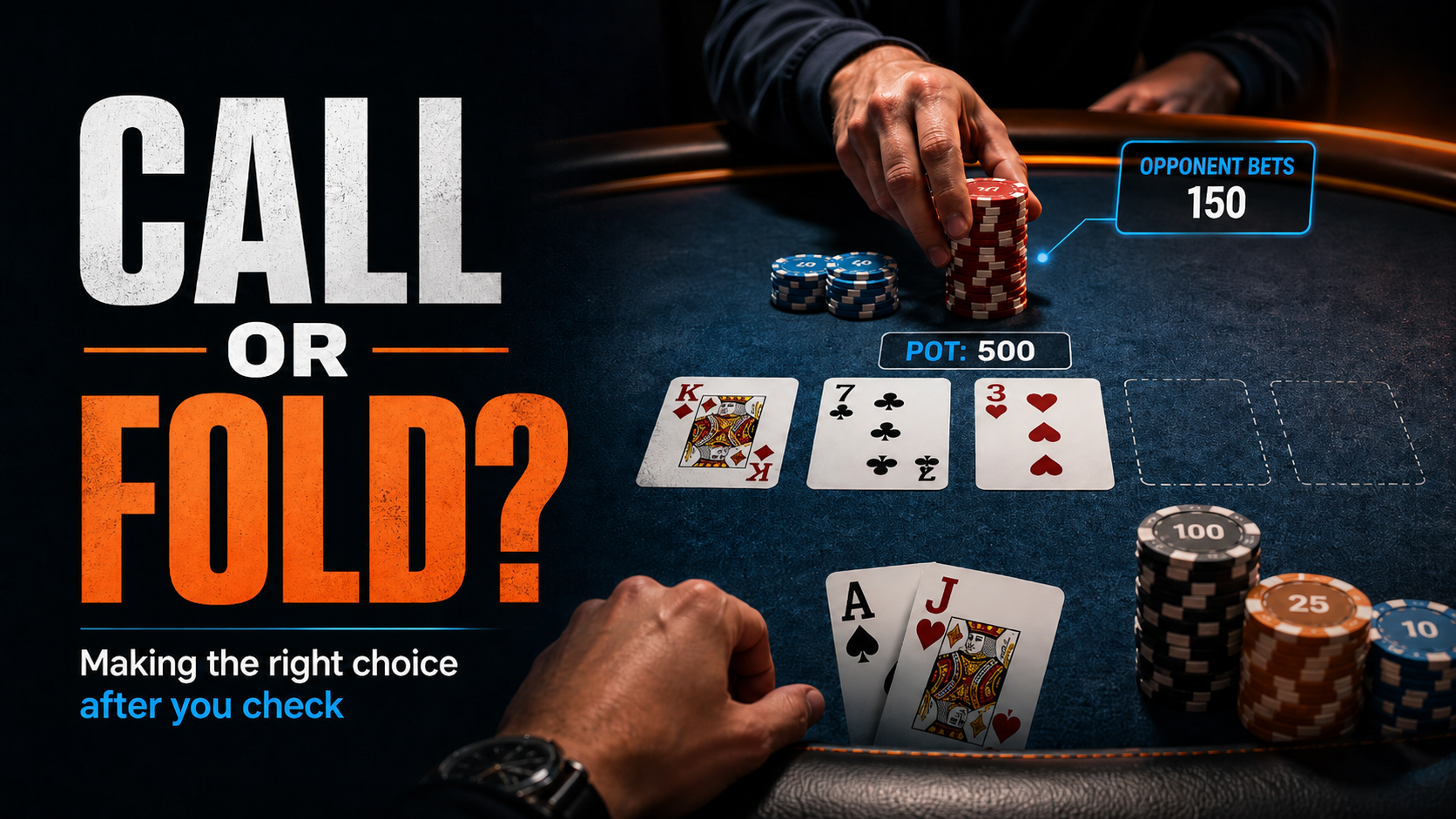
Most of your checks won’t lead to a check-raise. Here’s how to handle the rest.
Audio Version Available
Prefer to listen? Skip the reading.
5-min audio summary · Great for your commute · Same content, zero reading
In our last two articles, we’ve been building out the checking playbook. First, we explained when checking beats betting and introduced a five-factor checklist. Then we covered check-raising—the most powerful move that almost nobody at our table uses.
But here’s the reality: most of the time when you check and your opponent bets, you won’t have the kind of hand that calls for a check-raise. Check-raising is for strong hands, big draws, and specific protection spots. Everything else? You have a simpler decision—call or fold?
Getting this decision right is the difference between bleeding chips and playing smart defense.
Start With the Deal You’re Being Offered
Before you even look at your hand, look at the size of the bet. As we discussed in our article on risk vs. reward, every bet is a deal. A small bet offers you a generous deal—you don’t need to win often to make the call worthwhile. A big bet offers you an expensive deal—you need a much stronger hand or draw to justify continuing.
This one idea drives almost every call-or-fold decision after a check:
- Small bets (roughly a quarter of the pot or less): You can continue with a wide range of hands. Any pair, almost any draw, sometimes even Ace-high or King-high.
- Medium bets (around half the pot): You need a real reason to continue—a made hand, a solid draw, or a read.
- Large bets (three-quarters of the pot or more): You need a strong hand (usually a strong middle pair or better) or a big draw (like a flush draw or a good open-ended straight draw). Most weak hands without a clear draw should fold.
Keep this in your head as you read the rest. Every situation below bends depending on whether your opponent’s bet is small, medium, or large.
When to Check-Call
There are two types of hands that justify a check-call: made hands you want to keep the pot small with, and draws getting the right price.
Made Hands: Pot Control
You have a decent hand, but not a great one. Maybe second pair. Maybe top pair with a weak kicker on a connected board. Maybe an overpair on a scary flop. You’re probably ahead, but you’re not thrilled about playing a huge pot. Check-calling keeps the pot small. If you’re ahead, you win a reasonable amount. If you’re behind, you lose a reasonable amount.
Example: You have J♦️ 2♦️ in the big blind. Someone raised before the flop and you called. The flop comes J♠️ 8♣️ 5❤️. You have top pair, but a terrible kicker. You check, your opponent bets a third of the pot. Call. You might be ahead — your opponent might be bluffing or might have something like T-T or A-8. But you might also be up against a better hand like A-A or K-J. Calling keeps things manageable where raising may set you up to lose a big pot.
The more aggressive your opponent is, the more profitable check-calling can be because those aggressive opponents will be bluffing more and will be betting for value with weaker hands.1
Draws: Let the Bet Size Decide
When you have a drawing hand—a flush draw, a straight draw, a combo draw, or sometimes even just two big overcards—check-calling works whenever the pot odds justify it. The smaller the bet, the wider the range of draws you can call with.2
Example: You have 8♠️ 7♠️ in the big blind on a flop of 6♦️ 5♠️ 2❤️. You have an open-ended straight draw. Your opponent makes a small bet. That’s a generous deal—you only need to make your straight occasionally for the call to be worth it. Call and hope a 4 or a 9 comes.
The larger the bet, the better your draw must be (more outs, plus more confidence that you’ll win a big pot when you hit). Against a small bet, almost any draw can call—even just a couple of overcards or a backdoor flush draw. Against a large bet, you need a strong draw, ideally a combo draw or a draw to the nuts. A weak draw like a gutshot against a large bet is usually a fold.
When to Check-Fold
Sometimes, the right play is to let the hand go. Folding feels bad, but bleeding chips into pots you can’t win feels worse—especially when you’re out of position, as you will be anytime you face a bet after checking.
When You Have Nothing
If you called preflop with a speculative hand and the flop gave you nothing—no pair, no draw, no real way to improve—fold. Even against a small bet. The occasional lucky runout doesn’t justify calling with hands that have almost no way to win.
Example: You have 9♦️ 7♦️ in the big blind. The flop comes A♠️ K❤️ 4♣️. No pair, no straight draw, no flush draw, not even a backdoor draw. Your opponent bets. Fold. Even a small bet is a bad deal when you have essentially no way to make the best hand.
When the Bet Is Too Big
The larger the bet, the stronger your hand needs to be. Against a small bet, you can usually call with any pair and sometimes even Ace-high or King-high. Against a large bet, you should fold most Ace-high hands and often even your worst paired hands. A pair of deuces on a board with three overcards looks a lot worse against a large bet than against a small one.
This applies equally to draws. A gutshot is fine against a small bet but often a fold against a large one. A backdoor flush draw is usually a call against a small bet, but mostly a fold against a large one. Whenever the deal isn’t good enough, let it go.
The bet size is telling you something. Pay attention.
A Note About Multiway
Everything tightens when you add opponents. When someone bets into three or four players in a multiway pot, the odds are pretty good that the bettor or one of the other players has a real hand. The marginal one-pair hand or speculative draw that was an easy call against a small bet when heads-up becomes an easy fold multiway—especially if one or more players has already called the bet ahead of you.
The rule is simple: more opponents means you have to fold more hands.
The PPC-Specific Lesson
Our player pool is generally passive for now. Most opponents check behind far more often than they bet, which means you often won’t even face the call-or-fold decision—you’ll just see a free turn card. That’s a gift. Take it.
But when our opponents do bet into your check, it usually means something. Don’t try to make every “hero call” just because the pot is tempting. A bet from a passive player is more likely to be a real hand than a bluff. (Start paying attention to your specific opponents, though—a few players love to do the opposite: bluffing when they’re weak, but checking with their strong hands because they’re afraid of scaring you into folding.)
And remember the biggest takeaway from this whole series: check-raising (Article 2) is a powerful weapon that nobody at our table is using. If you have a strong hand or a big draw and you’re facing a bet, the answer isn’t always “call or fold”—sometimes it’s “raise.” Don’t let this article make you forget the one before it.
Your Challenge
The next time you check out of position and your opponent bets (and you don’t have a good enough hand to check-raise), pause and run through the checklist. First: how big is their bet—small, medium, or large? Second: what’s your hand actually doing—made hand, draw, or nothing? Third: if it’s a draw, how likely are you to hit it (remember the Rule of 4 and 2)? Fourth: are you heads-up or multiway?
Then make the call-or-fold decision with the bet size driving it. That single habit will save you a lot of chips over the course of a tournament.
Coming up next: We’ve now covered betting and checking in depth. But there’s a hidden factor that changes all of these decisions: how deep your stack (and your opponent’s stack) is. In our next article, we’ll look at effective stack size—the most important number at the table that most players never think about. Once you understand it, you’ll start seeing every hand differently.
- A note for our most experienced players: there are some situations where check-calling with a very strong hand can be more profitable than check-raising it—usually in rare circumstances where it is very unlikely that your opponent has a strong enough hand to call a raise, but might continue bluffing or pick up a strong enough hand to pay you off later. We’re deliberately not covering that here. Our table slow-plays too much already, and almost every spot where you have a monster after checking, the right move is the check-raise from our last article. If we revisit this in a future article, we’ll come back and update this one. ↩︎
- As discussed in our previous article, check-raising is also a great play with a strong draw. Ideally, you want to stay balanced—sometimes raising your draws and sometimes calling with them—to keep your opponents guessing. For now, try experimenting with the opposite of what you usually do: if you usually call and just try to make your hand (like most of our players), try a check-raise; if you are the type of player who aggressively bets every time you have a good draw, experiment with checking and trying to make your hand. Pay attention to how mixing it up works out. ↩︎