
The single most important post-flop play that ties together all your preflop strategy.
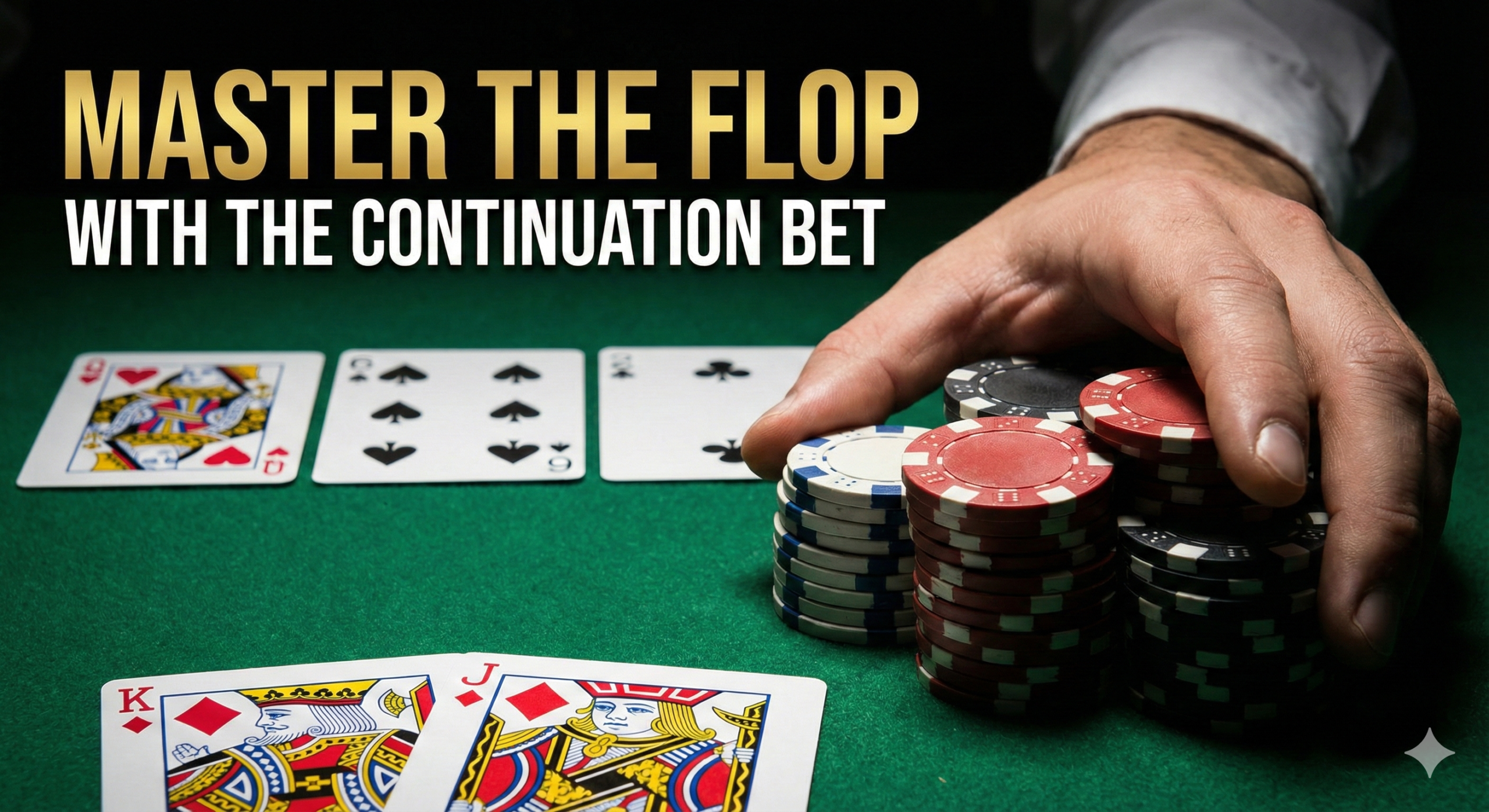
You raise with K♦️ J♦️, completely miss the flop, and your opponent folds a better hand. Sound like magic? It’s called the continuation bet, and it’s about to become your new favorite play.
Last year, we started this tip series with the most important fundamental preflop strategy: raise or fold instead of limping. This year, we’re starting with the most important fundamental flop strategy: the continuation bet (or “c-bet”). And here’s the best part—it builds directly on everything we’ve already discussed: raising preflop, paying attention to your position, recognizing what hands the players in the blinds should be playing, and knowing that most flops miss most hands.
What Is a Continuation Bet?
A continuation bet is simply betting on the flop after you were the preflop raiser. You’re continuing the aggression you started before the flop. That’s it.
Here’s a typical scenario: You raise preflop with K♦️ J♦️, and only the big blind calls. The flop comes Q❤️ 6♠️ 2♣️—you completely missed. No pair. No real draw. Should you give up and check? No! You should usually bet anyway.
But why? That’s where all those previous concepts come together.
Why the C-Bet Works: Tying It All Together
Think about what’s happening when you follow the preflop strategies we have recommended:
You raised preflop instead of limping. You’re playing stronger hands than opponents who limp with random cards. When your opponent called from the big blind, they might have almost anything—the big blind plays a very wide variety of hands because they’re getting a discount.
You were selective about position. You followed our advice about playing more hands in late position, which means that you are either playing in position against your opponent or you playing mostly very strong hands from early position.
You and your opponent(s) likely didn’t connect with the flop. As we covered in our recent article, unpaired hands only connect with the flop about 1/3 of the time. Your opponent probably missed too—and when you both miss, your “nothing” is often better than theirs (because you usually started with a better hand).
Let’s return to our scenario with K♦️J♦️ when the flop comes Q❤️ 6♠️ 2♣️, and let’s imagine that your opponent is holding A♦️ 4❤️. You both missed completely, and their Ace-high is beating your King-high. But if you bet one or two big blinds, the opponent should probably still fold their weak Ace-high. They don’t know you missed. They just see that you raised preflop and are now betting into a queen-high flop. It looks like you might have hit that queen, or at least have something stronger than their weak ace, such as A❤️K❤️ (because you very easily could have when you think about all the other strong hands that you would be playing in this situation!). So, they have to be concerned that even if they improve to a pair of Aces, they may still lose.
With that in mind, when you bet, they will often fold. And when they do, you win a pot with a hand that was currently losing. That’s the power of the c-bet.
When C-Betting Works Best
The c-bet is most effective when you are heads-up against one opponent, when you are in position, and when you are playing stronger hands on average than your opponent(s). Why? Because you started with better cards, you both most likely missed, and when two hands that both missed go to battle, the one showing aggression usually wins.
When you are against two opponents on the flop, you can still find good situations to continuation bet, but you should do so less frequently because it is more likely that someone connected with the flop. It’s harder to win with a bet when you’re trying to get multiple opponents to fold.
And when you are against three or more opponents, you should generally just default to betting when you have a good hand or a strong draw. The continuation bet is not really a relevant play at that point.
The Bottom Line
The continuation bet isn’t just another poker play—it’s the natural extension of good preflop strategy. When you raise preflop instead of limping, you establish yourself as the aggressor with stronger hands. When you follow through with a c-bet on the flop, you maintain that edge.
Remember: you raise preflop for two reasons: to build the pot with good hands and to give yourself a chance to win even when you miss. The c-bet completes that strategy. It keeps both ways of winning alive on the flop.
Your Challenge
Next time you raise preflop and your hand misses the flop, bet anyway if you’re up against just one or two opponents. Pay attention to how often your opponent(s) fold and how differently the hand plays compared to when you just check and give up. If you are playing a strong preflop strategy like we recommend, you should have many opportunities every game to try this out and start collecting information about how well it works.
Up Next
Now that we have discussed the most common post-flop bet, our next tip will take a step back and think about the different reasons that we might bet with different types of hands (betting as a bluff, betting for value, and more), and how that should affect your thought process.