
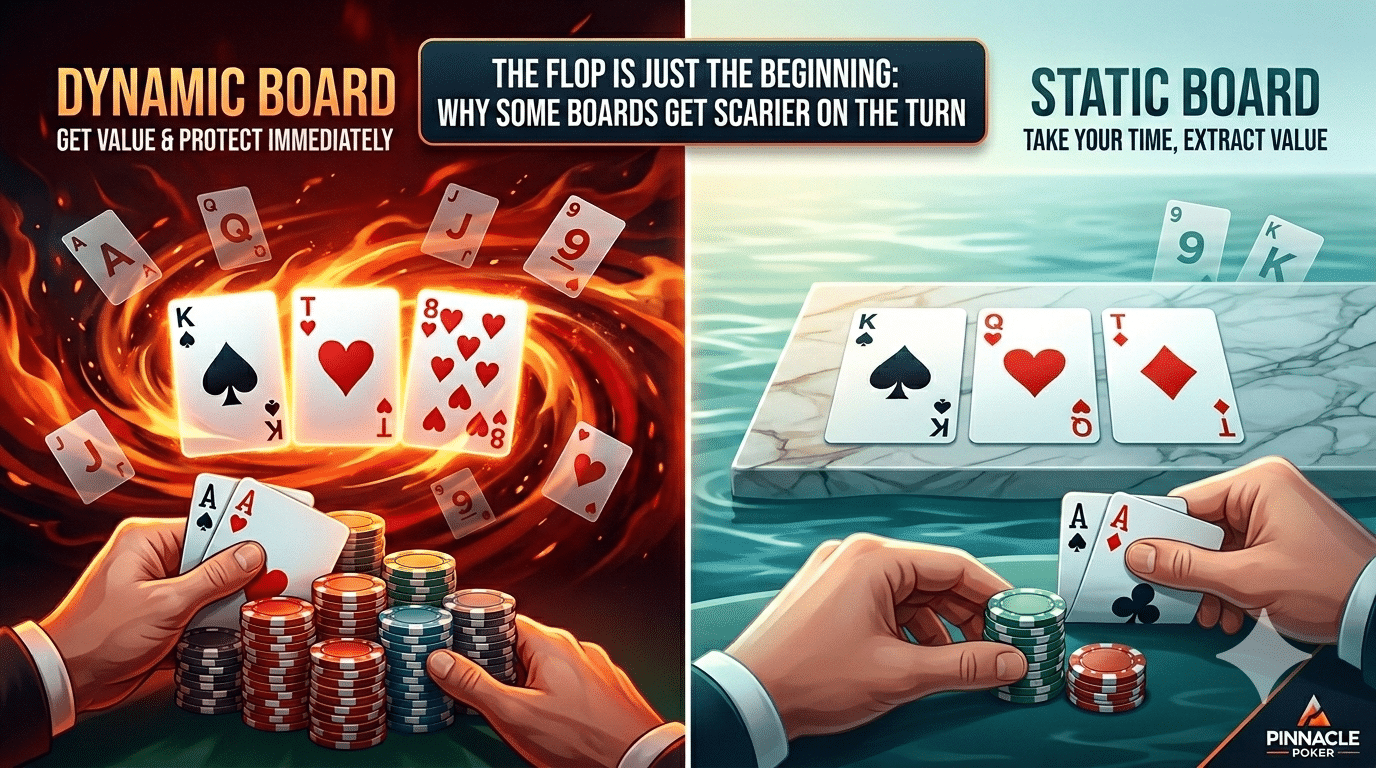
Knowing how much the board is likely to change with the next card is one key to smart bet sizing.
In our last article, we introduced the idea of board texture and looked at the first key question to ask on every flop: How connected is the board? Connected boards like K♠️ T❤️ 8❤️ help lots of hands; disconnected boards like 7♦️ 7♠️ 2♣️ help almost nobody.
But that’s only half the picture. Knowing that the flop helped your opponents tells you about right now. The second question is about what comes next: How likely is it that the turn or river card will change who’s winning?
This is the difference between dynamic boards and static boards—and it has a huge impact on how you should play your hand.
What Makes a Board Dynamic or Static?
A dynamic board is one where lots of upcoming cards could dramatically shift the situation. Flush draws, straight draws, and low cards (where just about any card creates a new top pair) make a board more dynamic. On dynamic boards, today’s best hand might not be tomorrow’s best hand.
A static board is one where the situation is unlikely to change much. Whatever hand is best on the flop will probably still be the best hand after the turn and river. There just aren’t many cards that can come to shake things up.
You might think connected boards are always dynamic and disconnected boards are always static. They often are—but not always. Connectivity is about how much the flop helped people right now. Dynamics is about how much the next card could change things. Let’s see this in action.
Connected and Dynamic: K♠️ T❤️ 8❤️
We discussed in the last article how this board is very connected—lots of hands have hit something. But it’s also very dynamic. Consider what happens on the turn:
- Any Ace, Queen, Jack, 9, or 7 completes at least one straight draw
- Any heart completes a flush draw
Add those up and that’s roughly half the remaining deck that could completely change who’s winning—even if one player has the absolute best hand they could possibly have on this flop (like K❤️ K♣️ for a set of Kings)!
If you have A♠️ A❤️ here, you’re likely ahead right now, but you’re sweating. You don’t want your opponent seeing cheap cards because so many turn cards are dangerous for you. This is exactly why we discussed betting for protection in a previous article—you want to charge your opponents for the chance to outdraw you on a board where lots of cards could do exactly that.
Connected but Static: K♠️ Q♦️ T❤️
This board is also very connected—and notice that only one card changed compared to K♠️ T❤️ 8❤️. The Q replaced the 8 and the flush draw disappeared. Those differences might seem small, but they have a big impact on how dynamic this board is.
The key difference: a straight is already possible. A player holding A♠️ J❤️ has flopped the best possible hand—the “nuts”—with a Broadway straight (A-K-Q-J-T). Because the straight is already made, straight draws are less relevant. There’s no flush draw either. The big drama on this board has mostly already happened.
For your pocket Aces, this is a tricky spot—but for a different reason than on K♠️ T❤️ 8❤️. There, you were worried about what might come next. Here, the concern is what has already happened. Some hands are already beating your Aces (like A-J for the straight), and your Aces are not going to catch up to those hands. But the good news is that there are still lots of strong hands your Aces are beating—hands like A♠️ K♣️, Q♠️ J❤️, J♠️ J❤️, and many similar hands. This is a spot where you can still bet for value against the many hands you’re beating, but you should bet smaller and be ready to slow down if your opponent raises or plays back aggressively.
Disconnected and Static: 7♦️ 7♠️ 2♣️
We discussed how almost nothing connects with this board. Now we can see that it is also extremely static. Think about what the turn card could be:
- If a 3, 4, 5, or 6 comes … so what? Anyone who now has a straight draw still needs another card to complete their hand
- Really the only turn card that could potentially threaten your Aces is another 2—giving someone with a random deuce a full house—and that’s very unlikely
- Any other card usually gives someone just a single pair (unless they got very lucky with a pocket pair and hit a full house)
If your Aces are ahead now, they will almost certainly stay ahead on virtually any turn card. You don’t need to bet big for protection here because there’s not much to protect against. In fact, you might want to bet smaller—not because you’re scared, but because you want hands like Q♣️ J♣️ or 9♠️ 8♠️ to call, even though they’re way behind. (Remember betting for value? This is a perfect spot for it.)
Disconnected but Dynamic: 5♣️ 4♣️ 4❤️
Here’s an interesting one. Like 7-7-2, this board looks harmless. The cards are low and paired, and most hands that people play don’t include cards this small. So it’s fairly disconnected—most hands haven’t hit it.
But unlike 7-7-2, this board has some dynamic qualities. The two clubs on the board mean that any hand with two clubs has a flush draw—and plenty of playable hands have two clubs (like A♣️ 8♣️, K♣️ J♣️, or 9♣️ 8♣️). The 5 and 4 are also close in rank, which means hands like 7❤️ 6❤️ have a straight draw. And 7♣️ 6♣️ has both a straight draw and a flush draw—what’s called a “combo draw”.
Your pocket Aces are almost certainly ahead right now, but you have more to fear on the turn—particularly if a club comes (completing possible flushes) or a card like a 3, 6, or 7 hits (completing possible straights). Best to try to get more value now while you are still confident in your hand’s strength.
How Dynamics Shape Your Betting
Last article, we discussed how connectivity affects your bet sizing—bigger bets for value and as bluffs on connected boards (because more of your opponents’ hands want to stick around), smaller bets on disconnected boards (because your opponents probably don’t have a hand that can call a big bet). Dynamics are similar: they affect how urgently you need to protect your hand with bigger bets.
Dynamic boards mean lots of turn and river cards could change the situation. If you have a strong hand, you want to protect it by making draws pay to continue.
Static boards mean the turn and river probably won’t change much. If you’re ahead, you can take your time extracting value. If you’re behind, you’re probably going to stay behind, so bigger bets will just get you into more trouble.
Putting It All Together
Between this article and the last one, you now have a simple two-question framework for reading any flop:
- How connected is this board? The more connected, the more likely someone has a strong hand or draw—and the larger you should consider betting.
- How dynamic is this board? The more dynamic, the less safe your current hand might be—and the more urgently you should protect a strong hand by making draws pay.
Getting into the habit of asking these two questions will make you a better player immediately—because it will change how you bet, not just whether you bet.
Your Challenge
At our next game, every time the flop comes down, try to categorize it along both dimensions before you act. How connected is it? How dynamic is it? You don’t need to be perfect—just get in the habit of reading the board before you look at your own hand’s relationship to it. You’ll be surprised how quickly it starts to feel natural.
Coming up next: Now that we understand whether to bet, why we’re betting, and how the board affects our strategy, our next two articles will tackle the natural follow-up: how much should you bet? We’ll start with the math behind different bet sizes—how a small bet and a big bet create different incentives for your opponents—and then follow up with the strategy of choosing the right size for the right situation.