
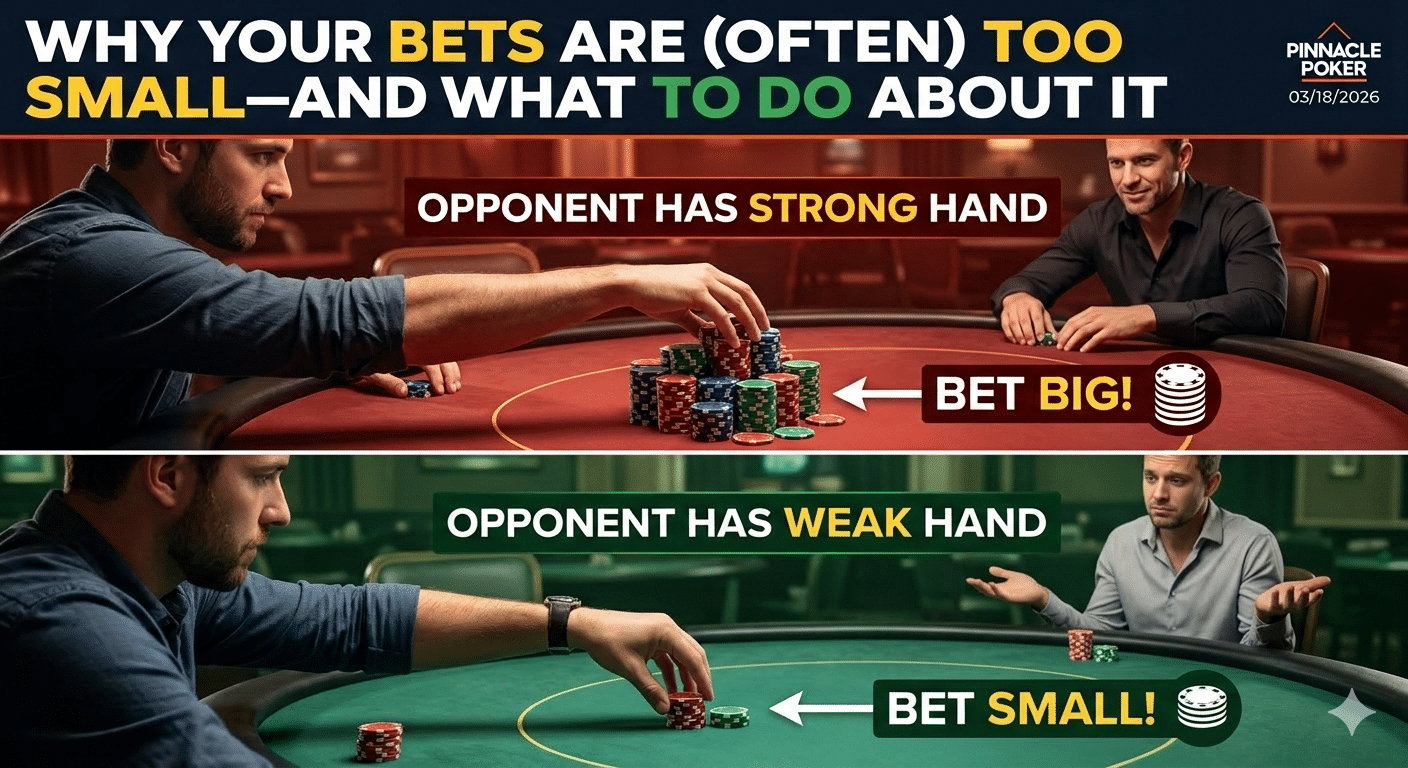
A bet that’s too small costs you chips whether you’re bluffing or holding the nuts.
You’re on the river holding 9♠️ 8♠️. The board reads K♣️ T❤️ 7♦️ 3♠️ 2❤️. You’ve got nothing—no pair, just a nine-high busted straight draw. Your opponent has checked to you, and there’s 2,000 in the pot. You decide to take a shot at it with a bluff. You toss in 200 chips.
Your opponent thinks for about half a second, shrugs, and calls with Q♦️ J♦️. No pair—just Queen-high. You lose the pot.
What went wrong? It wasn’t the decision to bluff—it was the size of the bluff. As we learned in our pot odds article, a 200-chip bet into a 2,000-chip pot gives your opponent an 11-to-1 deal. At that price, calling with almost anything is practically free. Your bluff never had a chance.
Now imagine a different hand on the same river. This time you’re holding K♠️ T♠️—top two pair. Your opponent checks, and again you bet 200 into the 2,000-chip pot. They call with A♣️ K❤️—top pair with the best possible kicker.
You won! But think about what happened. Your opponent had a very strong hand—strong enough that they would have happily called a bet of 1,200 or more. Instead of winning a pot of over 4,000, you won 2,400. You left over a thousand chips on the table—chips that were yours for the taking if you’d only asked for them.
Two different hands, two different goals, the same mistake: betting too small. The bluffer needed a bigger bet to have any hope of getting a fold. The value bettor needed a bigger bet to get paid what their hand was worth. These examples happen on the river, where the impact is easiest to see—there are no more opportunities to bet, so a bet that’s too small is just money left behind. But the same principles apply on the flop and turn, with the added consideration that draws and future cards make proper sizing even more important.
This is a common mistake we see in our games, and the goal of this article is to fix it.
Your Bet Size Is the Deal You’re Offering
In our [last article](https://pinnacle.poker/poker-math-made-easy-risk-vs-reward/), we looked at pot odds from the caller’s perspective—how to evaluate the deal your opponent is offering you. Now let’s flip it around. When you bet, you’re the one setting the terms.
Here’s the key insight: your bet size should match the situation. But—and this is important—that does not mean “bet small when you want calls and bet big when you want folds.” If you always bet small with good hands and big with bluffs (or vice versa), observant opponents will figure out the pattern. And more importantly, you’ll leave chips on the table with your best hands while wasting chips on bluffs that never work.
Instead, let the situation guide your sizing.
Bet Small (About 1/3 of the Pot) When Your Opponent’s Most Likely Hands Are Relatively Weak
In our articles on flop texture, we talked about flops where smaller bets make sense—disconnected, static boards like 7♦️ 7♠️ 2♣️ where your opponents are unlikely to have connected with the board. Let’s look at a turn example where the same logic applies.
Your opponent raises from middle position and you call from the big blind. The flop comes 7♦️ 6♣️ 5❤️. You check, and your opponent checks behind. The turn is the 4♠️.
Think about what your opponent is likely to have. They raised before the flop, which means they probably have big cards—hands like A♣️ Q♦️, K♠️ J❤️, or Q♣️ T❤️. Raisers don’t usually play many low cards, so it’s unlikely they have a strong hand like a straight or two pair on this board. Most of the time, they’ve got overcards that haven’t connected with anything. How big should you bet?
Betting small for thin value: Imagine you have J❤️ 7❤️—top pair with a decent kicker. That’s ahead of most of your opponent’s likely hands, but those hands are mostly just ace-high or king-high (or maybe a small pair). They might talk themselves into calling a small bet—“maybe my Ace-Queen is still good”—but they’re folding to a big bet every time. One-third of the pot squeezes some value out of those weak hands that a bigger bet would scare away.
Betting small as a cheap bluff: Now imagine you have J♣️ T♣️ instead—no pair, no draw. Even a small bet will get a fold from a lot of hands that are better than yours, like Q♠️ J❤️, Q♦️ T❤️, or K♣️ Q♦️. Your opponent missed the board, already gave up by checking the flop, and now has to face a bet on the turn. A small bet is all it takes, and it costs you very little when it doesn’t work.
The theme: Small bets work when the situation tells you your opponent’s hands are mostly weak. You’re either picking up thin value (betting with a medium strength hand that can still get worse hands to call) or winning the pot cheaply.
Bet Big (About 2/3 of the Pot or More) When Your Opponent’s Most Likely Hands Are Relatively Strong
In our flop texture articles, we also discussed connected and dynamic boards where bigger bets make sense—and we saw in the opening examples how a tiny river bet fails when your opponent has a real hand. Let’s look at a turn spot where a big bet is clearly right.
You raise and your opponent calls from the big blind. The flop comes A♦️ T❤️ 9❤️—a very connected board. You bet big, and your opponent calls. The turn is the 2♦️, putting a second suit on the board with two possible flush draws now out there.
Think about what your opponent is likely to have. They called a big bet on a connected flop—that means they’ve got something real. Hands like T♣️ 9♣️ (two pair), A❤️ 5❤️ (top pair and a flush draw), K♣️ T♣️ (middle pair with a good kicker), or Q♠️ J♠️ (an open-ended straight draw) are all in the mix.
Betting big for premium value: Imagine you have A♠️ T♠️—top two pair, one of the best hands you can have here. Your opponent likely has a strong hand too, and strong hands call big bets. If you bet one-third of the pot, they’ll call. If you bet two-thirds or full pot, they’ll still call. The difference is many more big blinds’ worth of chips going into your stack instead of staying in theirs.
Betting big as a serious bluff: Now imagine you have 7♠️ 6♠️ instead—you bluffed big on the flop (remember those continuation bets?) and got called. You didn’t catch anything helpful on the turn. Your opponent has already called one big bet, so they have something worth defending. Even their weakest likely hands—something like K♣️ 9❤️ or 8♣️ 7♠️—may not fold to a tiny bet. A bigger bluff forces them to decide whether their hand is really strong enough to continue.
The theme: Big bets work when the situation tells you your opponent likely has a real hand. You’re either getting maximum value or you need a serious bet to have any chance of pushing them off it.
“But What If They Fold When I Have a Great Hand?”
This fear keeps a lot of players betting too small. You have a monster and think: If I bet big, they’ll fold!
The question to ask is: how likely is it that your opponent actually has a weak hand in this situation? If you have top two pair on a connected board and your opponent called a bet on the flop, the chance that they have nothing is low. They stuck around because they have something. Monster hands are rare—so when you get one, you want to win as big a pot as possible.
So, if your opponent is most likely to have a good—or at least reasonable—hand, try to build a big pot! Sometimes, they will have a weak hand that would have called a smaller bet and you will miss out on a few chips. But if you have judged the situation accurately, then you will make many more chips from your opponents’ strong hands than you will lose from their folds.
“But What If They Call When I’m Bluffing?”
Same principle, other direction. If you bluffed big on a connected board where your opponent likely had a real hand, the bluff was always a long shot—but a bigger bet gave you the best chance.
Getting caught is the cost of doing business. Here’s a bonus math tip to tuck away for later: a two-thirds-pot bluff needs to work only 40% of the time to be a good bet.1 That means if you make one of these big bluffs and get called half of the time, you are actually making money. Plus, when your opponents see you bluff big, they’re more likely to call your big bets in the future when you actually have a strong hand. Getting caught now sets up big paydays later.
Before You Bet: A Quick Checklist
So, how do you decide on your bet size? Don’t worry about being perfect. Just think about a few factors and pick a size that fits best with the situation.
What’s the board look like? Disconnected and quiet? Lean smaller. Connected and dynamic? Lean bigger.
What does my opponent likely have? Have they been passive so far (mostly checking or just calling small bets)? They may have a weaker hand, and a small bet may be best. Have they called big bets already or been betting aggressively? They probably have a stronger hand that warrants a bigger bet.
What’s my goal? Think back to the three reasons to bet. Thin value or cheap bluff? Go small. Premium value, protection, or a bluff that needs to push out a real hand? Go big.
Your Challenge
In your next game, pick one orbit (one full trip around the table) and pay attention to bet sizes—yours and everyone else’s. When you see a tiny bet, ask yourself: Is this the right size, or is the bettor giving away a cheap deal? When it’s your turn, size based on the board and the situation, not on what feels “safe.” If the board is connected and your opponent has shown strong interest in the hand, take a deep breath and bet two-thirds of the pot (or bigger!). You might be surprised how much more you make with your good hands—and how many more folds you get with your bluffs.
Coming up next: We’ve spent the last several articles talking about when and how to bet. But sometimes the best play is to not bet at all. Our next article will explore when and why you should check—and why checking isn’t always a sign of weakness.
- This is a different version of the same risk/reward formula that we talked about in our last article. If the pot has 3,000 chips in it, and you bet 2,000 chips as a bluff, you are risking 2,000 chips to win 3,000 chips. That’s a 3-to-2 deal that you are giving yourself on this bluff. To figure out how often any bet needs to work, just use the following formula: Risk/(Risk + Reward). Here, that means: 2/(2+3) = 0.4 or 40%. ↩︎