
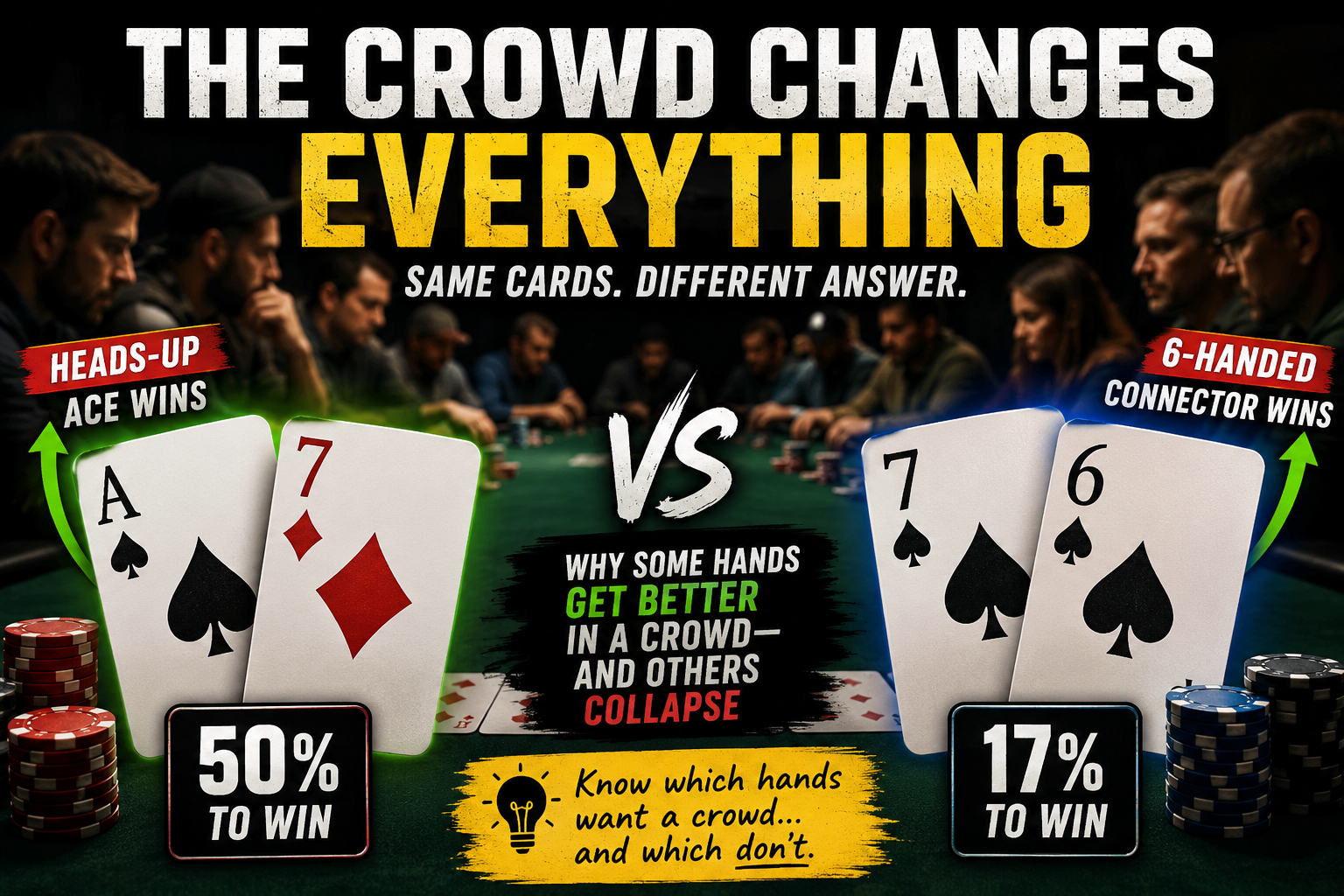
Everyone’s chances drop when more players join in. The trick is knowing whose chances drop fastest.
⸻
Audio Version Available
Prefer to listen? Skip the reading.
4-min audio summary · Great for your commute · Same content, zero reading
⸻
Quick question before we start. You can choose one of two hands to be dealt tonight: A♠️ 7♦️ or 7♠️ 6♠️. Which do you want?
Most players grab the Ace without thinking twice. And against a single opponent, they’re usually right—the Ace is the better hand, comfortably.
But at a crowded table, with five other players in the pot, that answer flips. The 7♠️ 6♠️ becomes the hand you want, and it isn’t close.
Today we’re going to put real numbers on why that is.
First, Your Fair Share
Every player in a pot puts in chips. If everyone’s hand were equally good, everyone would win an equal share of the time. That’s your fair share, and it’s easy to find: one divided by the number of players.
- Heads-up (2 players): 1 in 2, or 50%
- 3 players: 1 in 3, or 33%
- 4 players: 1 in 4, or 25%
- 5 players: 1 in 5, or 20%
- 6 players: 1 in 6, or about 17%
Win more than your fair share and you’re making money in the long run. Win less and you’re donating. Here’s the part that trips people up: when more players enter the pot, your chances of winning always go down—but your fair share drops too. The real question isn’t whether your chances fall. It’s whether they fall faster or slower than your fair share.
Some Hands Get Better Against Multiple Opponents, While Others Collapse
We dealt out hundreds of thousands of hands, giving our opponents the kinds of hands people at our tables actually play—any pair, any Ace, any suited King, the best high-card hands, and some of the most connected hands, roughly the top 38% of all starting hands—and ran every board to the river. What did we find?
Heads-up, A♠️ 7♦️ wins 50% and 7♠️ 6♠️ wins 40%. You definitely want that Ace.
Six-handed, A♠️ 7♦️ collapses to 10% while 7♠️ 6♠️ holds at 17%. Now you want that suited connector.
Raw percentages are a fine start, but they hide the real story, because everyone’s chances fall in a crowd. To compare hands fairly, divide each hand’s chances by its fair share. Call it the cushion: how many times your fair share you’re actually winning. Above 1.0 is profitable; below 1.0 is losing.
We chose hands you’ll recognize from our own games—premium down to the big-card, weak-kicker hands we all limp too often.
| Hand | Heads-up | 4 players | 6 players | Notes |
| A♠️ A❤️ | 1.7× | 2.4× | 2.7× | grows a lot |
| A♠️ K♠️ | 1.3× | 1.4× | 1.4× | grows |
| A♠️ K♦️ | 1.3× | 1.3× | 1.2× | shrinks |
| K♣️ Q♦️ | 1.0× | 1.1× | 1.1× | grows |
| 7♠️ 6♠️ | 0.8× | 0.9× | 1.0× | grows |
| 5♣️ 5♦️ | 1.1× | 1.0× | 1.0× | approximately flat |
| Q♦️ 4♦️ | 0.8× | 0.8× | 0.9× | never clears 1.0 |
| K♣️ 3♦️ | 0.8× | 0.7× | 0.7× | never clears 1.0 |
| A♠️ 7♦️ | 1.0× | 0.8× | 0.6× | collapses |
Two things jump off the page.
A♠️ K♠️ and A♠️ K♦️ are the same two ranks—one suited, one not. Heads-up they’re identical at 1.3×. But pile in players and the suited version climbs while the offsuit version slides a bit. That single suit is the difference between a hand that is fine with a crowd and one that wants fewer opponents.
The big-card, weak-kicker hands are quietly hopeless, especially against more than one player. A♠️ 7♦️ is break-even one-on-one but wins just 0.6× its fair share six-handed—worse than 7♠️ 6♠️, worse even than Q♦️ 4♦️. And K♣️ 3♦️ and Q♦️ 4♦️ never clear 1.0× at any table size. They’re losing hands whether the pot is small or crowded.
Why a Crowd Punishes Disconnected Big Cards
Two things are going on, and neither is complicated.
The more players in the pot, the stronger the hand you need to win it. We tracked what actually won each pot. Heads-up, one pair (or worse) wins 40% of the time. Four-handed, that drops to 23%. Six-handed, just 14%—meaning two pair or better wins 86% of crowded pots. Straights and flushes both roughly double in frequency. So a hand hoping to make one strong pair is chasing something that rarely wins against several opponents; a hand that makes straights and flushes is chasing exactly what does.
And in a crowd, someone usually holds a better version of your hand. Picture it: you limp in with A♠️ 7♦️, four players follow, and the flop comes A❤️ 9♣️ 4♠️. Top pair, Aces—you start betting and you’re not planning to stop. What you can’t see is another player who tagged along with A♣️ T♦️: your exact pair of Aces, but a Ten kicker instead of your seven. You hit one of the better flops you could hope for, and you’re still behind. Heads-up, one opponent probably doesn’t have that better Ace. Against five, someone usually does.
That’s also why K♣️ Q♦️ survives a crowd better—far fewer hands have it out-kicked, and it can still make a straight. It is not only about suited versus offsuit. It’s also about domination and the ability to make a straight or flush.
If you carry one line to the table, make it this: in a crowd, one pair rarely wins—so the hands you want are the ones that can grow into a straight or a flush.
Two Honest Caveats: The Math Isn’t the Whole Story
Winning more than your fair share against a crowd isn’t the same as wanting to be in the pot against a bunch of opponents.
For example, A♠️ A❤️ has the biggest cushion on the board six-handed, 2.7×—so why do strong players still try to thin the field with it? Because raw chances aren’t everything. Aces usually make just one pair, and one pair can be hard to play in a crowd: you often end up in situations where you can’t bet big and you never quite know where you stand. A hand can be mathematically ahead and still practically tricky to play.
Another example: 5♣️ 5♦️ sits at almost exactly 1.0× no matter the table size—barely break-even on paper. Its real value comes from implied odds and the fact that it is often easy to play after the flop: either it hits three of a kind (and tries to get a bunch of money in) or it doesn’t (and it mostly gives up). Small pairs are fine in a cheap, crowded pot for reasons the raw number doesn’t fully show.
Both of these examples — and other considerations — are what our next article is about.
⸻
Your Challenge
Next game, watch what wins at showdown whenever several players see a flop: one pair, two pair, or better. We’re betting that a single pair rarely takes down a crowded pot.
Then, before you limp along behind three others, lean on a simple rule of thumb: the hands with two cards that can’t build a straight together—weak Ace-high and King-high hands like A♠️ 7♦️ or K♣️ 3♦️, especially when they’re not suited—are your easiest folds in a crowd. You don’t have to fold every time. But when you play one, you’ll know you’re swimming upstream.
⸻
Coming up next: Now that we know some hands don’t mind a crowd and others hate it, the obvious question is what to do about it. Our next article covers the choice you face when someone raises in front of you—or when three players have already limped and it’s on you. Some hands are happy to call and take their chances in a crowd. Others want to raise, thin the field, and get heads-up where they belong. And others just want to get out of the way. We’ll show you how to tell which one you’re holding.