
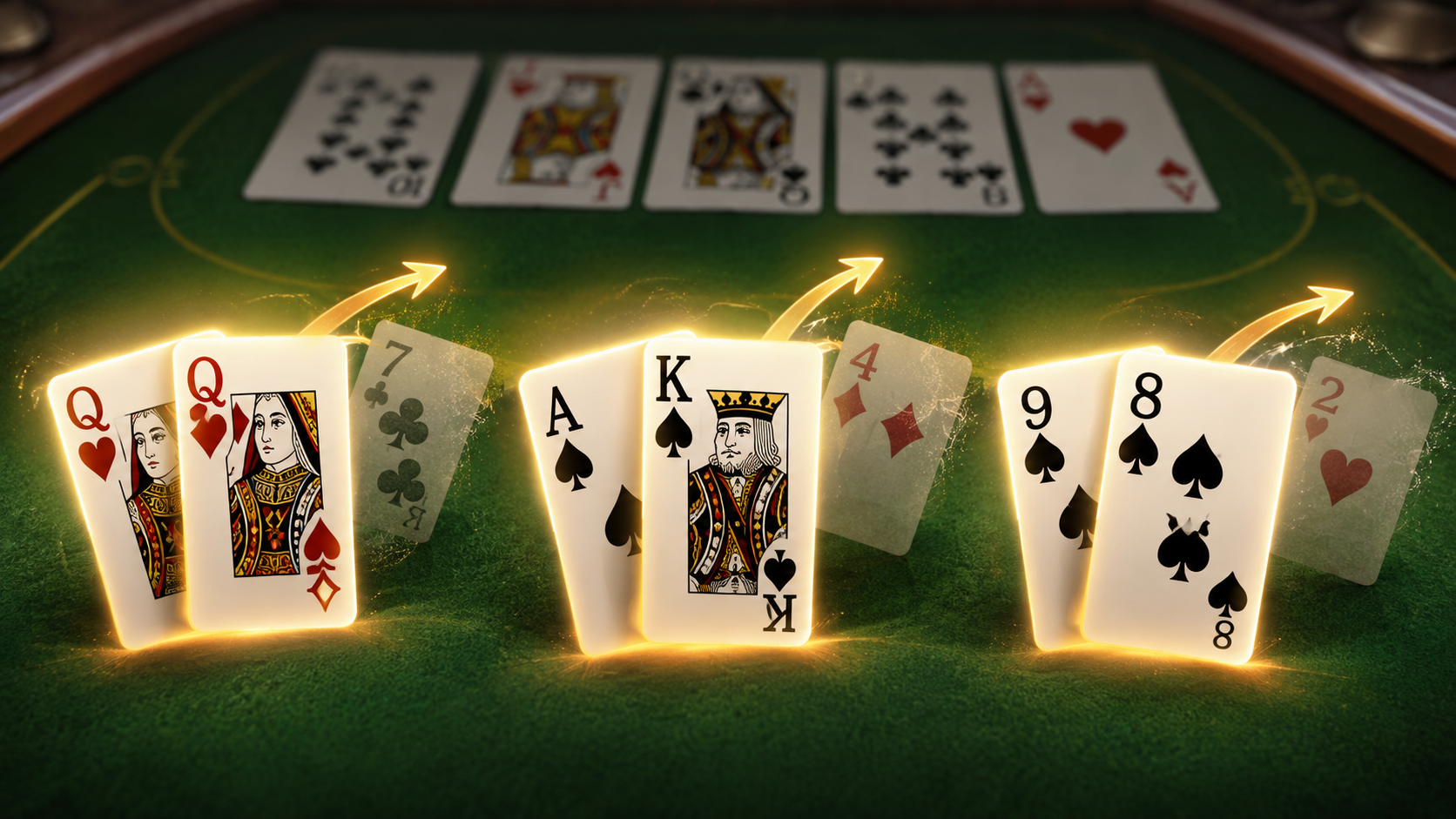
When everyone keeps the best two of three cards, everyone’s hand gets better. Here’s by how much.
Audio Version Available
Prefer to listen? Skip the reading.
5-min audio summary · Great for your commute · Same content, zero reading
We’ve covered the rules and the discard. Now the part that will actually cost people chips on September 5 if they don’t see it coming.
Here’s the whole idea in one sentence: when every player at the table keeps the best two of their three cards, every player shows up to the flop with a better hand than usual. Including your opponents.
That sounds obvious. What isn’t obvious is how big the difference is.
What You’ll Actually Be Dealt
A year ago we published What You Will Actually Be Dealt, which counted up how often each kind of starting hand shows up in Hold’em. Those numbers came from counting all 1,326 two-card combinations.
We counted all 22,100 three-card combinations for Pineapple. Here’s the comparison:
| Hold’em | Pineapple | ||
| You’re dealt a pair | 5.9% | 17.2% | 2.9× as often |
| You’re dealt two cards of the same suit | 23.5% | 60.2% | 2.6× as often |
Read that second row again. In Hold’em you get a suited hand about once every four deals. In Pineapple, three deals out of five give you two cards of the same suit to keep.
Which Means More Flushes, and a Lot More Sets
Here’s the part that needs no guesswork at all. After the discard, this is Hold’em. Everyone has two cards, the board runs out normally, and the chances of a hand improving are exactly what they’ve always been:
- Two cards of the same suit make a flush by the river 6.4% of the time.
- A pair makes three of a kind — a set — by the river 19.2% of the time.
Those numbers don’t change between the two games. The only thing that changes is how many people are holding those cards in the first place, and we just counted that. So multiply:
| Hold’em | Pineapple | ||
| A given player reaches the river with a flush | 1.5% | 3.9% | 2.6× |
| A given player reaches the river with a set | 1.1% | 3.3% | 2.9× |
Expect roughly two and a half times as many flushes and three times as many sets on September 5.
Now put that at a table of six. In Hold’em, somebody at a six-handed table turns up with a set in about 1 hand in 15. In Pineapple it’s about 1 hand in 5.
So What Do You Do About It?
Three practical adjustments. None of them are complicated.
1. Top pair is a good hand, not a great one
In Hold’em, when you flop top pair with a decent kicker, you’re usually happy to put chips in on the flop, turn, and river. In Pineapple, that same hand runs into a set or a flush far more often.
Keep betting it on the early rounds — you don’t want to give free cards to hands that are even more likely than usual to have strong draws. But when a normally cautious player raises you on the turn or the river — or calls multiple big bets — believe them a little sooner than you would in Hold’em. The hands that beat you are simply more available in this game.
2. A connected board is more dangerous than it looks
We introduced connected boards — flops where the cards work together, like J❤️ T❤️ 9♠️ — in a recent article. A connected board is scarier in Pineapple, for a simple reason: everyone had more suited and connected cards to start with. The hands that hit that flop hard are exactly the hands people chose to keep.
A flop of Q❤️ 6♠️ 2♣️ is only slightly more dangerous in Pineapple compared to Hold’em. A flop of 9♠️ 8♠️7❤️ is far more dangerous than usual.
3. Bet bigger, especially with your good hands
This is the one that matters most for us, because it combats a common tendency for our players: we bet too small. We’ve written about it directly.
Small bets are a bad idea in a game where opponents hold better cards than usual. A quarter-pot bet gives every flush chaser at the table a cheap card, and there are two and a half times as many of them tonight. Those small bets also win you fewer chips when your opponent hits a strong but second-best hand. And those second-best hands will be stronger and more frequent in this game.
When you make a strong hand, bet like it — half the pot, two-thirds, sometimes more. And think in pot fractions, not chip counts: “two-thirds of the pot,” not “I bet 500.”
The Silver Lining
Everything above cuts both ways. Yes, your opponents have better hands. But so do you — you kept the best two of three as well. Two and a half times as many flushes means two and a half times as many flushes for you.
The players who do well in our finale won’t be the ones who play scared. They’ll be the ones who bet their strong hands properly and don’t fall in love with one pair.
📌 Your Challenge
Count them. On September 5, keep a running tally of every flush and every set you see at showdown at your table, and compare it to a normal night. We bet you’ll see a noticeable increase.
Coming up next: Now that we’ve completed our detour into Pineapple, we’ll return to our usual tips on Hold ‘Em, starting with a series of articles focused on how to play certain specific hand types pre-flop (pairs, suited connectors, etc.).
Related reading: What You Will Actually Be Dealt· Some Hands Thrive in a Crowd. Yours Might Not. · You Can Only Win What They Have · Someone’s Already in the Pot. Do You Raise, Fold, or Call? · Not All Flops Are Created Equal · Why Your Bets Are (often) Too Small